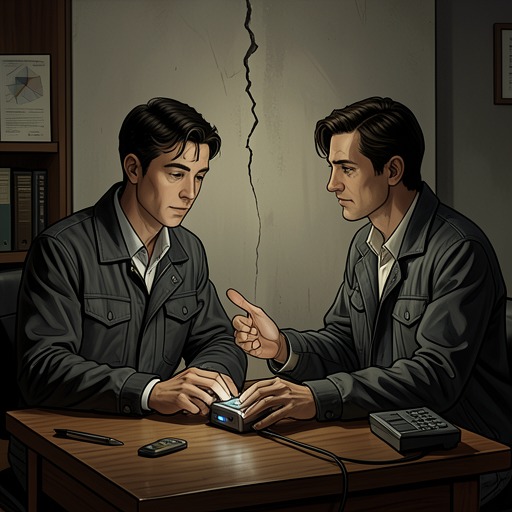
Brianna publicly responds to the petition to remove her song
On the Come UpBrianna publicly responds to the petition to remove her song by confronting the way “On the Come Up” has been framed as a threat. After an article in The Clarion calls for the track’s removal from Dat Cloud and connects it to violence, she answers in an Instagram Live that rapidly draws hundreds of viewers. Her response rejects both censorship and the assumption that lyrics explain students’ actions, insisting instead that the song is hers to express and that she has more to say.
The Petition and Its Framing
The controversy reaches Brianna through a link to a Clarion article titled “On the Come Up” Should Come Down: Local Teen Rapper’s Violent Song Leads to Violence. Its writer, Emily Taylor, says her thirteen-year-old son likes the track and describes its references to guns and antipolice sentiment as material that parents should stop. The article embeds video from the Ring parking lot and presents Brianna as a gang-affiliated, unruly teenager who had recently been removed from a local establishment.
Taylor also connects the song to the uprising at Midtown, arguing that a song encouraging violence encouraged students to act violently. She ends by asking Dat Cloud to remove “On the Come Up” and directs readers to a petition, presenting removal as necessary to protect children. Brianna objects that the article turns her into a villain on the basis of one song, without asking why students were protesting. In her view, its demand to protect children leaves her outside the category of children worth protecting.
Brianna’s Public Response
Rather than answer only within the newspaper’s framing, Brianna closes her door and starts an Instagram Live. The audience grows unusually quickly: she says that usually only Sonny and Malik join, but this time roughly a hundred people are watching within seconds. As she explains that the petition seeks to take her song off Dat Cloud, she calls it censorship and calls the effort foolish. The visible increase from one hundred viewers to three hundred, then four hundred and five hundred, gives her rebuttal a growing public audience.
Brianna tells viewers that they do not understand the song because it is not for them to understand. She does not deny its language about being armed; instead, she says that if she has to be ready, that reflects the discomfort she experiences every day. The distinction matters: the lyrics are not an invitation to treat her as a source of violence but an expression shaped by her own circumstances. She raises her middle finger to the viewers and addresses Taylor and anyone else criticizing the song, saying they may get it removed but will not silence her. The livestream makes her refusal public, not merely private anger at an article.
From Edited Song to Public Accusation
The article’s argument builds on an earlier television report that had already reduced “On the Come Up” to selected fragments. The report identifies Brianna as a local rapper, shows her Dat Cloud page, describes the track as violent and popular with young listeners, and airs portions with profanity bleeped. That treatment places her words in a news narrative about attacks on law enforcement rather than allowing the song to stand in its complete context. Taylor’s article extends this association from the edited song to the Midtown uprising and then uses the Ring parking-lot video to characterize Brianna herself.
The later Hot 105 interview shows the dispute continuing beyond the livestream. Asked about the petition and claims that the song led to a school riot, Brianna responds that she is angry and objects that news coverage ignored why students were protesting. Hype interrupts her to say that the lyrics about being armed go too far and to suggest that she implies she would kill police officers. Brianna rejects that reading and challenges the gendered double standard: Hype says her words surprised him because she is a sixteen-year-old girl, but says he was not similarly surprised when her father rapped about such things at sixteen. The interview makes explicit what the petition’s child-protection language obscures: Brianna is judged not only as a young artist, but through expectations attached to her race and gender.
Performance, Authorship, and the Meaning of the Song
The petition debate also echoes a broader pressure on Brianna to perform an identity others recognize. Earlier, a man at a music gathering mocks the idea of a girl rapper and expects nursery rhymes; Brianna answers with a put-down that earns laughter and acceptance from some of the men. Aunt Pooh had warned her that she would have to work twice as hard for half the respect, remain as tough as the men, and show no weakness. The episode establishes that resistance to being underestimated is part of Brianna’s work as a rapper, not an attitude invented for the controversy.
That pressure takes a different form when Supreme advises Brianna to play whatever role the industry expects, using outsiders’ assumptions to her advantage. He reveals that he encouraged Law to rap about street life and associate with the GDs to look authentic, even though Law had been working to support his family and had not begun as a gangster. Supreme warns Brianna to play the role rather than become it, but his business advice treats her public image as something to manage for profit. The petition’s claim that a song reveals a dangerous person and Supreme’s advice to adopt an expected role both risk making a performance stand in for the person. Brianna’s response insists on her authorship rather than accepting either interpretation as the whole truth.
The Song’s Refusal to Be Reduced
The song’s later freestyle gathers these tensions into an explicit statement of purpose. Brianna refuses to be a joke, a pet, a puppet, a clone, or the reason a child joins a set; she insists on using words that are her own. She presents herself as a daughter, sister, hope, and mirror, and argues that listeners assume she will rap about violence to increase other people’s profits. The verse rejects the conversion of what she observes into a claim that violence defines her identity: she can speak about what she sees without saying that it is who she is.
That distinction gives the public response its lasting significance. Brianna’s livestream does not make the petition disappear, nor does it settle the argument about how listeners interpret the track. Instead, it establishes that the debate cannot be confined to outsiders’ readings of lyrics and video clips. Against a campaign that seeks to remove her song in the name of protecting children, she speaks as a young person with her own account of daily discomfort and of the conditions the song addresses. Her defiance is therefore about more than keeping one track online: it is a claim to remain the speaker of her own work.